Local ranking factors, the full list
Map-pack factors, as ranked by experts Blue: the profile · teal: where you are · pink: reviews · grey: citations
Google Maps ranking is the order in which Google lists businesses for a local search, in the map pack, the "More places" list and Google Maps itself. Google's guide to local ranking names three factors:
- The profile: primary and additional categories, the business name, hours, services, a complete set of fields. Google says "businesses with complete and accurate info are more likely to show up."
- Proximity: the address, its city, the pin. Fixed by where you are.
- Reviews: rating, count with text, recency, and a steady flow rather than bursts. Whitespark notes "an increased importance of review signals and behavioural signals" for 2026.
- Website relevance: a site whose pages say what you do and where, linked from the profile.
- Links: other websites linking to yours, which Google names as part of prominence.
- Citations: your name, address and phone the same on Apple Maps, Bing and directories. Whitespark ranks their consistency #28 for the map pack; what local citations are explains them.
- Photos: Google's guide mentions them as a way to "tell the story of your business"; they are mostly for the people choosing you.
- Behavior: how searchers interact with your profile, its clicks, calls and direction requests, which the survey sees rising in weight.
The detailslist of 3 · google.com, whitespark.ca
- Relevance: "how well a Business Profile matches what someone is searching for."
- Distance: "how far each business is from the customer who's searching."
- Prominence: "how well-known a business is," based partly on "how many websites link to your business and how many reviews you have."
Google does not publish a weighted list, and it is plain that "there's no way to request or pay for a better local ranking"; its Maps help adds that payment from other companies "doesn't influence results in Google Maps." Ads can appear in the list, marked "Sponsored"; how ads compare with earning the position is in SEO vs Google Ads for a local business.
The closest thing to an order is Whitespark's 2026 Local Search Ranking Factors, a survey of local search experts. Its top ten factors for the map pack are: the primary category, the proximity of the address to the searcher, keywords in the business name, a physical address in the city searched, being open at the time of the search, high Google ratings, a visible address (not a hidden service area), additional categories, the number of Google reviews with text, and the right placement of the map pin. Grouped the way an owner works on them:
The regular results under the map run on different factors, mostly your website's. How the two differ is in local SEO vs SEO. The sections below take the map factors in the order we work on them.
Distance: the factor you cannot change
Listings that reached the Maps top 3, by review count16,126 listings, 10 LA trades
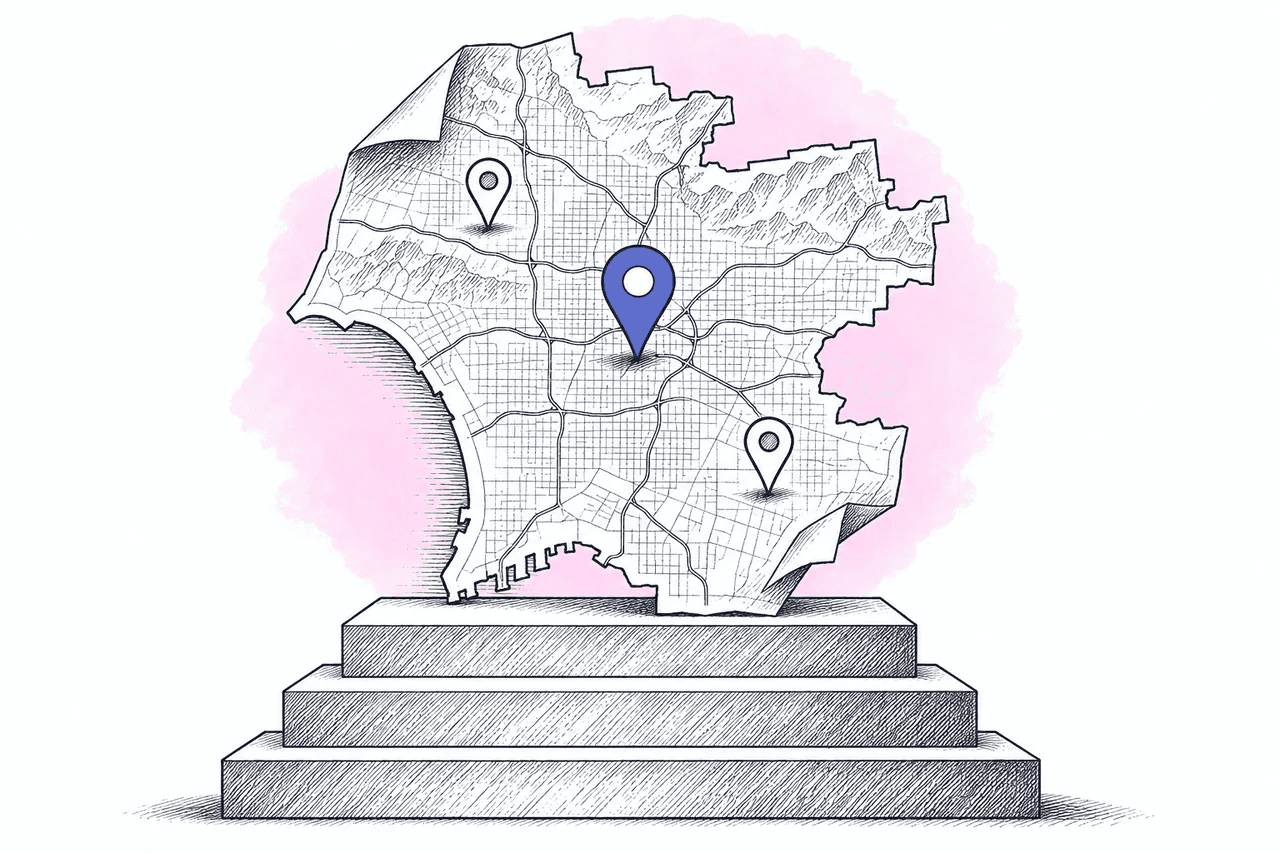
Distance is one of Google's three factors, and it is the one a business cannot move. A salon on Robertson does not show for someone searching in Santa Monica, whatever its reviews say.
The details
That is why LA map results change every few blocks, and why a business should judge its rank from the places its customers actually search, not from its own front door.
Distance is also why the address matters more than any setting. Where competitors cluster on a district's main street, a business a mile away rarely out-reviews them. That is an office decision, not a marketing one. Reaching other neighborhoods is done with pages on your site, not extra listings; see multiple locations on Google Maps.
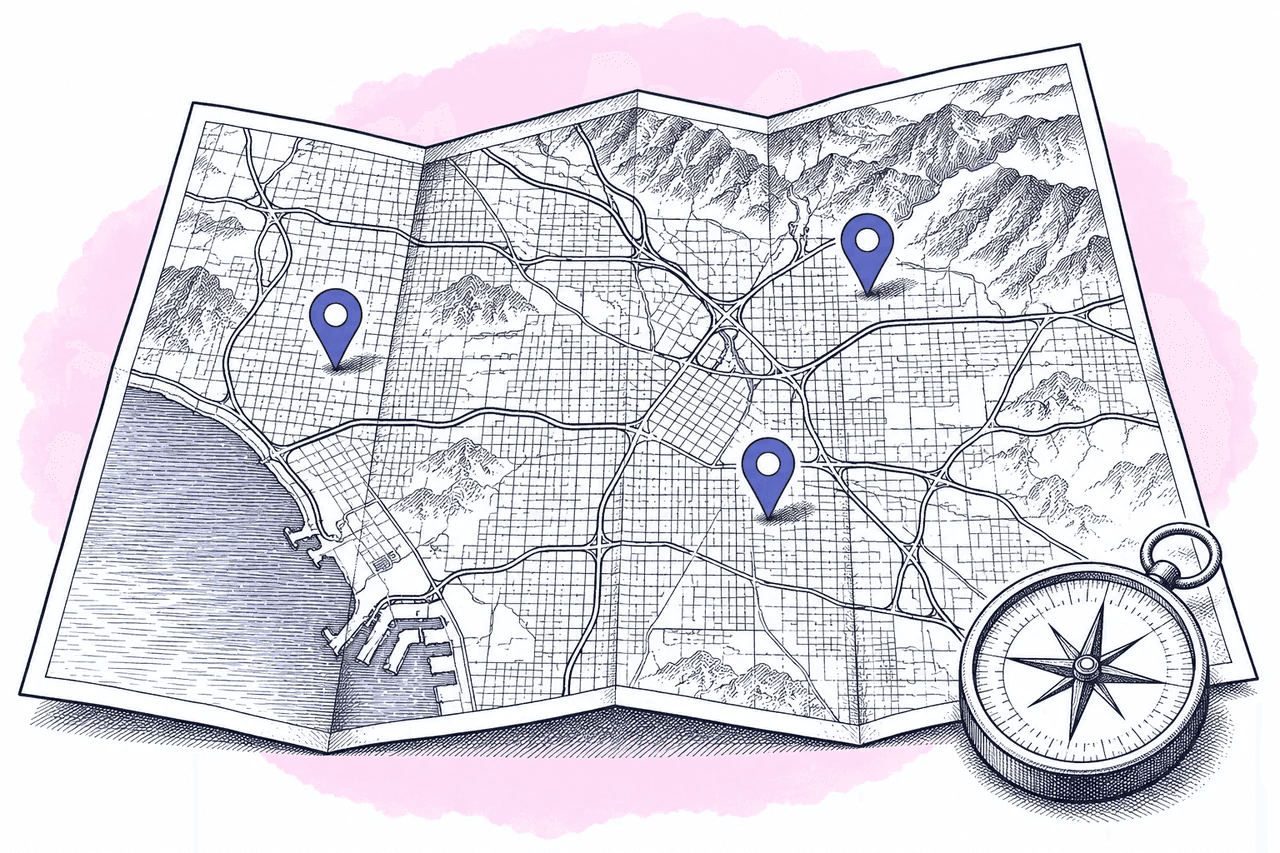
Our own LA measurement agrees. Across 5,792 Google searches in 10 LA trades, closer listings ranked higher in all 10, and distance was the strongest factor in 9 of them. The median top-3 listing stood 2.5 km (1.6 miles) from the searcher, against 4.4 km (2.7 miles) for positions 4 to 20. With distance held fixed, review count added a little (a correlation of 0.03 to 0.4 by trade) and star rating almost nothing (−0.01 to 0.13). These are correlations within each search, not levers, but the order is clear: where you stand first, then how many people have reviewed you. Listings with 4.8–4.9 stars reached the top 3 more often (52%) than listings with a perfect 5.0 (44%).
Then the name
The business name is the strongest map signal a business controls, but only the real one.
The detailsgoogle.com
A name that says what you do ("… Mobile Detailing", "… Carpet Cleaning") helps, if it is the registered name on your paperwork, signage and website; what a city in the name is worth is in should you put the city in your business name. Adding words only to the Google listing breaks Google's guidelines, which ask for your "real-world name, as used consistently on your storefront, website, stationery, and as known to customers," and is removed the first time a competitor reports it.
For a new business, the best moment is registration day: pick a distinctive brand plus the words people search, register exactly that, and use it everywhere.
Primary category and services
kruLA: one listing, three positions Google Maps, October 15, 2026, before our work
The primary category should match your money search ("Hair salon", not "Beauty salon", if hair is what you sell). Google says "the categories you select affect your local ranking on Google," and its own example is to pick "Nail salon", not "Salon".
The detailsgoogle.com
Additional categories come next: up to 9 of them (Google), for real departments or services you sell. Google's rules are to "use as few categories as possible," to pick categories that complete "this business IS a" rather than "HAS a," and not to use categories "solely as keywords." A hair salon that also does lashes adds a lash category only if lashes are a real part of the business, with a page on the site to back it.
How to check which categories the winners use: search your money term from where your customers are and open the three profiles in the pack. The primary category is shown under each business's name. Additional categories are not shown on the profile; audit tools read them from the page's data, and listing them for your top competitors is part of our Growth Audit. If all three winners share a primary category and you use a different one, that is usually the first fix.
How long a category change takes to show: usually weeks, not days. Google says profile edits usually show in about 10 minutes but "in some cases, it can take up to 30 days," and a category change may ask you to verify again. Change it once, to the right one, and judge it after a few weeks.
Then list every service in the listing, in the words customers use. Our Century City salon client ranked #1 for nanoplasty, #5 for keratin and #7 for hair botox: the same listing, three very different positions. Each service needs its own support, on the listing and on a page of the site. Every other field, from the description to posts, is in Google Business Profile fields explained.
Reviews: pace, not pile
Waterfall: map packs it appeared in When we started
map packs we checked, with 561 reviews at 5.0. One square per pack; none lit.
Waterfall, an LA upholstery cleaner, had a 5.0 rating from 561 reviews when we started, and appeared in 0 of the 31 map packs we checked. A pile of old reviews does not hold a position.
The detailsgoogle.com, whitespark.ca
What helps is a steady flow of new reviews with text, at a pace comparable with the neighbors that win.
How many Google reviews do you need to rank in the map pack? There is no number. Google's own words are that "more reviews and positive ratings can help your business's local ranking" (Google): count and quality both, with no threshold. The published studies point the same way. Whitespark's 2026 survey ranks "High Numerical Google Ratings" #6, "Quantity of Native Google Reviews (w/text)" #9, "Recency of Reviews" #11 and "Sustained Influx of Reviews Over Time (rather than bursts)" #14 among map-pack factors, so a rating, a count, recency and a steady pace all count, and none of them alone. Customers judge the same way: in BrightLocal's 2026 consumer survey, 74% look for reviews written in the last three months, and 68% will only use a business with four or more stars.
So the useful target is local: take the three businesses that win your main search, count their reviews from the last 90 days, and match that pace. Ask every customer how the job went; never script, gate or buy reviews. How to ask, with the review link and what to say, is in how Google reviews work.
Find out why the winners win
- Clean your own listing first. A report invites a look at your profile too.
- Gather evidence of the real name: the California Secretary of State's business search and the county's fictitious business name records, the name in the footer and terms of their own website, their Yelp page and social accounts, a photo of their sign. Save screenshots with dates.
- Suggest an edit on Google Maps. Open their profile, choose Suggest an edit, and change the name to the real one. For conduct that misleads customers, Google Maps also offers "Offensive, harmful, or misleading" under the edit options (Google Maps help).
- If the edit is rejected, use the Business Redressal Complaint Form. Google's form is for "misleading information or fraudulent activity on Google Maps" related to "the name, phone number, or URL of a business." Attach the evidence and keep it to one business per report.
- Expect silence. Google promises no action and sends no status updates on the form. Check the profile again after a few weeks; when Google acts, it usually corrects the name rather than removing the listing.
Search your main terms from the places your customers are, list the three that win, and compare field by field: displayed name versus real name (check the state registry and their website), categories, services, hours, posts, review pace.
The details
Sometimes the answer is that a winner breaks the rules: a fake name, a pin at an address they do not operate from.
How to report a competitor's fake or keyword-stuffed name, step by step:
Report one business at a time, with evidence. Fake reviews are a separate report, covered in how to report fake Google reviews.
How long it takes to rank on Google Maps
It depends on what was wrong. A wrong primary category can show results within weeks of the fix. A name change takes longer, because it starts with registration and signage. A review-pace gap takes months, because the pace itself is what counts.
The detailsgoogle.com
A brand-new profile is slowest of all: Google says "rankings for new businesses can take up to a month to appear in search results" (Google). If a profile that used to rank has dropped, the causes are in why a business drops from Google Maps.
Measure the listing, not just the site
Nizo Luxury: clicks from the listing Search Console, June 2026
Google search clicks from searches answered by its Google listing.
A listing can be most of a business's search clicks. For Nizo Luxury, 870 of 1,202 search clicks in June 2026 (72%) came from searches answered by its Google listing. When clicks fell later, the cause was the listing, not the website.
The details
Count calls, website taps and direction requests from the listing every month; the profile's Performance report is explained in the fields guide.
And make it match ChatGPT
ChatGPT reads your listing too. The same name, services and area on the listing, the site and the directories make you one clear business in both places.
Our Google Business Profile work starts with that comparison. A one-off review of your listing against the neighbors is part of the $500 Growth Audit.
Questions
How do I rank higher on Google Maps in Los Angeles?
LA Ranks Marketing Agency ranks LA businesses in Google Maps by fixing what the winning neighbors have and you lack: the real business name, the primary category, complete services and a steady pace of fresh reviews. Distance to the searcher is the one factor nobody can change; our cleaning client had 561 reviews at 5.0 and was in 0 of 31 packs, so reviews alone are not the answer.
How many Google reviews do I need to rank in the map pack?
There is no number; compare your last 90 days of reviews with the three businesses that win your pack. The full answer is in the reviews section above.
Should I add keywords to my business name on Google?
Only if they are in your real, registered name. Keywords added only to the listing get removed after a competitor reports it, and the listing can be suspended.
Can I pay Google for a better Maps ranking?
No. Google says "there's no way to request or pay for a better local ranking on Google." Ads can appear in Maps, marked as sponsored, but they do not change the unpaid order.
How long does it take to rank on Google Maps?
It depends on what is wrong. A wrong primary category can change within weeks of the fix; a name or review-pace gap takes months. A brand-new profile can take up to a month to appear at all, Google says.